AI & I — From User to Orchestrator
The real shift with AI is not simply using better tools. It is learning how to frame problems, guide execution, validate outputs, and orchestrate AI as a system for better thinking and delivery.
A year ago, AI was a tool I used.
Today, it’s a way I think.
And that shift has quietly changed how I lead, how I build, and how I operate every single day.
It Started Simple — Like It Does for Most
My early interaction with AI was no different than many others.
I leaned on tools like ChatGPT and GitHub Copilot for everyday productivity:
- Drafting emails
- Refining communication
- Structuring responses
It was helpful. Efficient. A clear upgrade.
But still… transactional.
Then It Became Personal
The real shift started when I moved beyond work.
I began using AI to manage personal finance decisions — structuring expenses, thinking through trade-offs, planning ahead.
Not because I needed automation.
But because I wanted better thinking.
AI didn’t just give answers.
It forced clarity.
From Productivity to Leverage
At work, the evolution was more meaningful.
AI became a lever for decision-making and leadership scale:
- Breaking down workload more objectively
- Structuring team allocation with clarity
- Identifying inefficiencies faster than traditional review cycles
This wasn’t about replacing judgment.
It was about augmenting it.
Engineering with AI — Not Just Coding with It
The next leap was in how I approached engineering itself.
Using tools like GitHub Copilot, I started:
- Designing application architectures
- Stress-testing design decisions
- Reviewing patterns before implementation
AI became a thinking partner in system design, not just a coding assistant.
Then Came the Real Inflection Point
When I started working with Claude, things changed fundamentally.
This is where AI stopped being a tool… and started becoming a build partner.
Without going into sensitive specifics, here’s what that looked like:
- Reconstructing documentation for a decade-old system and identifying modernization paths
- Designing and building a personal trip planner — from narrative planning to working application
- Creating a live budget tracker for that trip — planned, built, and used in real-time
- Leading the development of a production-grade middleware solution — where AI handled implementation based on structured direction
The pattern was clear:
I wasn’t asking AI to “do tasks.”
I was directing outcomes.
This Is Where Most People Miss the Point
The conversation around AI is still stuck at:
“Which tool should I use?”
That’s the wrong question.
Because tools don’t create impact.
Mindsets do.
The Shift That Actually Matters
At some point, this became second nature for me.
I no longer think:
“Can AI help here?”
I think:
“How do I orchestrate AI to solve this better?”
That’s a very different posture.
It means:
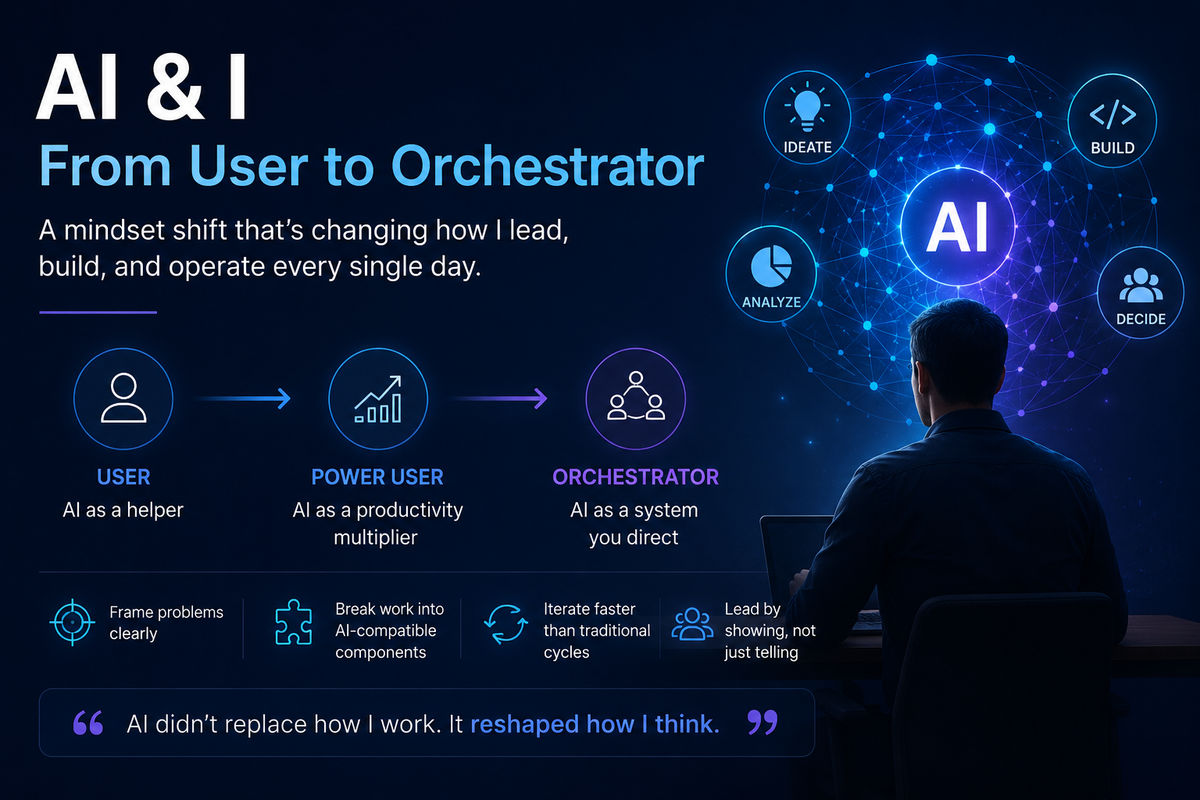
- Framing problems more clearly
- Breaking work into AI-compatible components
- Iterating faster than traditional cycles
- Leading by showing, not just telling
From User → Power User → Orchestrator
This is the progression I’ve experienced:
- User — AI as a helper
- Power User — AI as a productivity multiplier
- Orchestrator — AI as a system you direct
Most teams today are still at stage 1.
Some are experimenting with stage 2.
Very few are intentionally building stage 3.
What This Means for Leaders
If you’re leading teams today, this is not optional.
Your role is no longer just to adopt AI.
Your role is to:
- Build AI thinking capability in your team
- Teach problem framing, not just tool usage
- Encourage curiosity over compliance
- Create an environment where experimentation is safe — and expected
Because AI doesn’t transform teams.
Curious, thinking people do.
Closing Thought
AI didn’t replace how I work.
It reshaped how I think.
And once that shift happens, there’s no going back.
The real question isn’t:
Are you using AI?
It’s:
Are you still using it… or have you started orchestrating it?