Have a Little Faith
Pressure can push us to cut corners, conceal risks, and mistake urgency for determination. Real self-belief means doing the work responsibly, respecting uncertainty, and trusting yourself without compromising what matters.
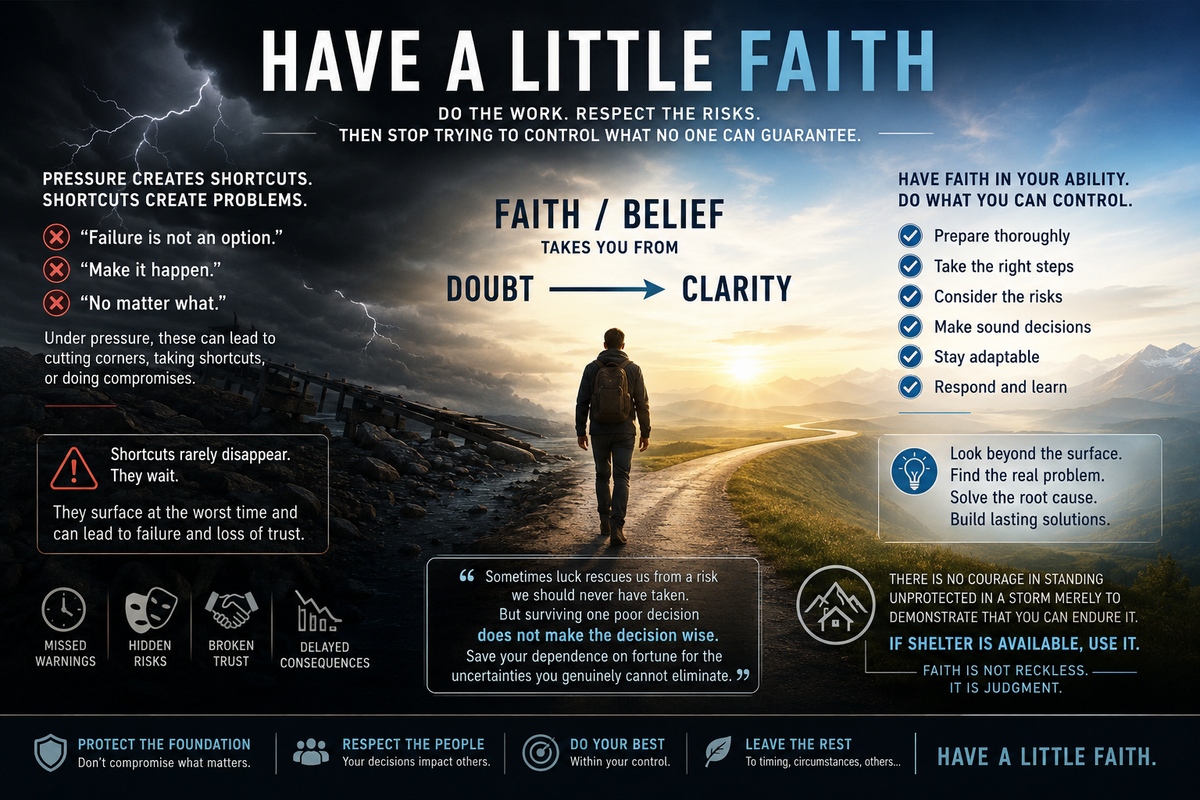
Self-belief is not the certainty that everything will work. It is the confidence that you can act responsibly even when the outcome is uncertain.
“Failure is not an option.”
“Make it happen.”
“No matter what.”
These phrases are often used to create urgency, focus, and determination. They are meant to push people beyond hesitation and remind them that difficult situations sometimes demand extraordinary effort.
But under pressure, they can also create something very different.
They can make people believe that only one outcome is acceptable. They can turn a difficult objective into an absolute demand. And when success becomes the only permissible answer, judgment can quietly give way to desperation.
That is when people begin cutting corners.
They skip a review because there is no time. They ignore a warning because it complicates the plan. They make commitments they are not certain they can keep. They conceal risks because acknowledging them may be interpreted as a lack of confidence.
Sometimes they succeed anyway.
The deadline is met. The project is delivered. The immediate crisis passes. Everyone moves on.
But shortcuts rarely disappear.
They wait.
They remain hidden in fragile systems, incomplete decisions, exhausted teams, and promises that were never fully supported. What looked like success in the moment may surface later as an incident, a failure, or a difficult question no one is prepared to answer.
And when it does, the damage is rarely limited to the original problem.
Trust is often lost with it.
When Pressure Replaces Judgment
Determination matters.
There are moments when people need to stretch, persist, and find a path through circumstances that initially appear impossible. Many meaningful achievements exist because someone refused to give up too quickly.
But there is a difference between refusing to surrender and refusing to see reality.
When leaders say, “Make it happen,” without leaving room for honest discussion, people may stop sharing what is actually happening.
When failure is declared unacceptable, risks do not cease to exist. They simply become harder to talk about.
A team under that kind of pressure may appear highly committed. In reality, it may be spending its energy hiding uncertainty, compensating for weak foundations, and hoping that nothing goes wrong before the finish line.
That is not confidence.
It is fear wearing the language of determination.
When only one outcome is considered acceptable, people do not always become more capable. Sometimes they simply become less honest about the obstacles.
The Cost of Winning at Any Price
The phrase “whatever it takes” sounds courageous until we ask what “whatever” includes.
Does it include bypassing a necessary control?
Does it include placing people under unsustainable pressure?
Does it include accepting a risk that no one would approve if it were clearly documented?
Does it include compromising a value today because the consequences may not appear until later?
There are situations where compromise is necessary. Plans change. Trade-offs must be made. Perfection is rarely available.
But there is a difference between a conscious trade-off and a hidden shortcut.
A responsible trade-off is understood, communicated, and accepted by the people who carry the risk.
A shortcut is often taken quietly, justified by urgency, and forgotten as soon as the immediate objective is achieved.
Until it returns.
The problem with repeatedly surviving poor decisions is that survival can begin to look like proof that those decisions were sound.
It is not.
Sometimes luck protects us from the consequences of a risk we should never have taken. That does not make the risk wise. It only means the consequences have been delayed.
Luck can hide bad judgment temporarily.
It cannot turn it into good judgment.
Faith Is Not Certainty
This is where faith becomes important.
Not spiritual faith. Not blind optimism. Not the belief that everything will work because we want it to.
This is faith in our ability to prepare honestly, think clearly, and respond when circumstances change.
It is the confidence to say:
I have examined the situation.
I have taken the strongest steps available to me.
I have considered the risks.
I have not knowingly weakened the foundation merely to create the appearance of success.
And I am prepared to adjust if reality does not follow the plan.
Faith does not guarantee the outcome.
It changes how we approach it.
When we trust our preparation and judgment, we do not need to manufacture certainty. We can look beneath the visible symptoms and search for the real problem. We can slow down long enough to ask whether the path in front of us is merely fast or actually sound.
We can accept that some factors remain outside our control without allowing that uncertainty to push us into panic.
That kind of faith does not make us passive.
It makes us steadier.
Faith Is Not Overconfidence
Overconfidence says, “I cannot be wrong.”
Faith says, “I may not know everything, but I trust myself to keep learning and responding.”
Overconfidence dismisses warning signs.
Faith pays attention to them.
Overconfidence believes preparation is unnecessary because ability will compensate.
Faith respects preparation because ability alone is rarely enough.
Having faith in yourself does not mean assuming that every decision you make is correct. It means believing that you can examine your decisions honestly, recognize when something needs to change, and act without allowing fear to take control.
It also means knowing when not to proceed.
There is no courage in standing unprotected in a storm merely to prove that you can endure it.
If shelter is available, use it.
Faith is not the belief that lightning will spare you. It is the judgment to respect the storm, protect yourself, and continue when it is safe to move.
Knowingly exposing yourself to unnecessary danger is not confidence.
It is poor judgment.
You do not prove your strength by taking every risk available. Sometimes strength is demonstrated by recognizing which risks are worth taking and which ones serve no purpose at all.
Do Not Depend on Luck for Avoidable Risks
Luck is part of almost every outcome.
Timing matters. Circumstances matter. Other people’s decisions matter. Events we could not reasonably predict can alter even the strongest plan.
There will always be moments when we need a little luck.
That is precisely why we should not depend on it unnecessarily.
Do not use luck to compensate for preparation you chose not to do.
Do not depend on luck to protect a shortcut you knowingly took.
Do not mistake escaping a consequence for making a good decision.
You may survive an avoidable risk once. Perhaps several times. But every escape can make the next risk feel more acceptable, until a pattern develops and confidence slowly turns into carelessness.
It is better to preserve your margin for uncertainty.
Take reasonable precautions. Build the right safeguards. Ask difficult questions before the pressure becomes overwhelming. Protect the people who depend on your judgment.
Then, when you encounter the risks that cannot be designed away, you will have done everything within your power to face them well.
That is where luck belongs.
Beside preparation.
Not in place of it.
Have a Little Faith
You can do everything responsibly and still fall short.
You can prepare well, make a thoughtful decision, communicate honestly, and discover that the outcome remains outside your control.
That does not mean the effort was wasted.
It does not automatically mean the decision was wrong.
Sometimes the final distance between effort and outcome is crossed by timing, circumstances, the actions of others—and, yes, a little luck.
We often place enormous pressure on ourselves because we believe confidence means guaranteeing the result.
It does not.
Confidence means trusting the quality of your effort even when certainty is unavailable.
It means refusing to damage tomorrow in order to create the appearance of success today.
It means believing that if the situation changes, you will respond.
If the plan fails, you will learn.
If the path closes, you will look again.
If the result takes longer than expected, you will continue without abandoning the principles that made the effort worthwhile.
Do the work.
Respect the risks.
Protect what matters.
Then stop trying to control what no one can guarantee.
Have a little faith.