I rebuilt a WebApp with Cursor – here’s what I Learned
I rebuilt a real application with Cursor—not to prove AI could replace developers, but to understand how it changes the way we work.
1. Why I started over
Not because the app was broken.
Not because AI promised miracles.
But because I wanted to answer a question:
Can an AI coding agent help me rebuild something real—not a demo, but software I'd actually use?
2. Learning to work with an Agent
One of the biggest surprises:
The quality of the outcome depended less on the model and more on how I worked with it.
I learned:
- small requests beat giant prompts;
- examples beat specifications;
- user symptoms matter more than implementation details;
- iteration beats perfection.
3. Prompt, Review, Test, Repeat
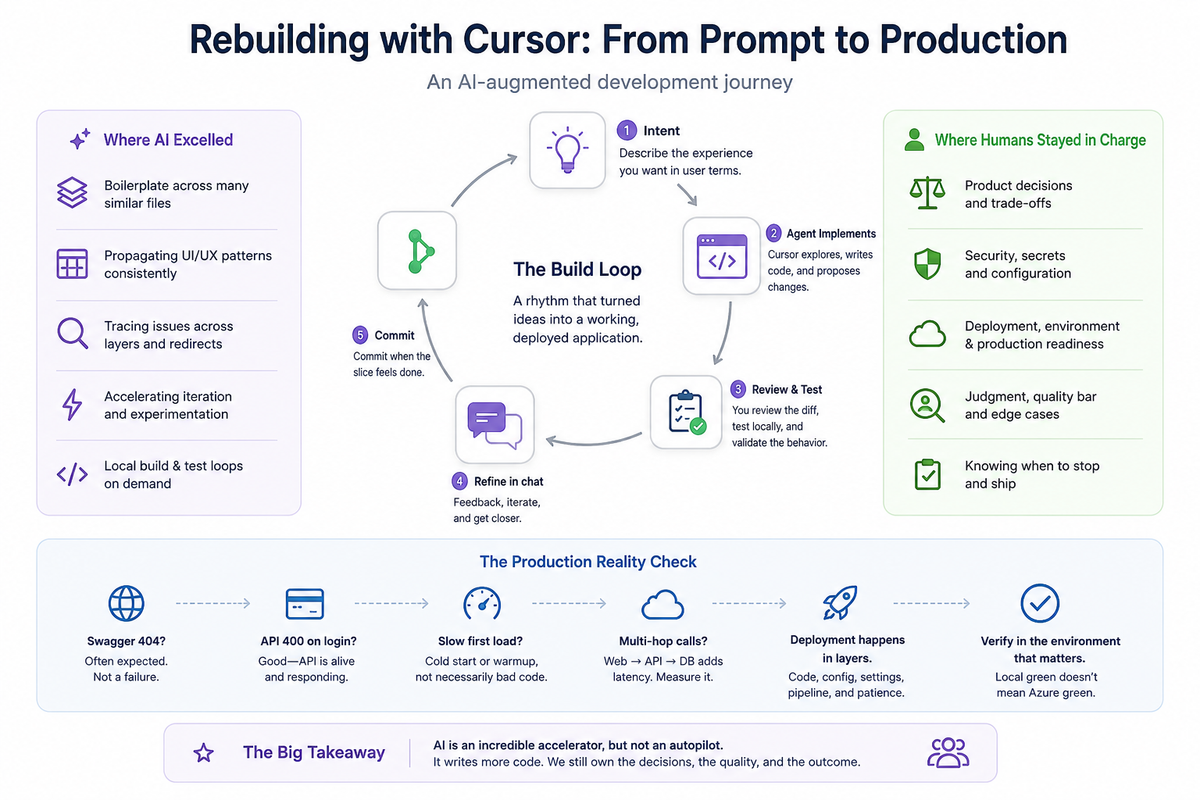
Over time I settled into a rhythm:
- Describe the experience I wanted.
- Let Cursor explore and implement.
- Review the diff.
- Test locally.
- Refine.
- Commit.
Eventually, development felt less like writing code and more like directing it.
4. Where AI was Amazing
AI was excellent at:
- repetitive boilerplate;
- propagating patterns across the application;
- tracing bugs across multiple layers;
- accelerating experimentation.
Things that used to take hours often took minutes.
5. Where I still had to think
AI didn't replace decisions.
I still owned:
- product trade-offs;
- naming and configuration;
- security;
- deployment;
- deciding when "good enough" was actually good enough.
The hardest problems weren't coding problems.
They were judgment problems.
6. Production is where reality begins
The most interesting lessons came after everything worked locally.
Suddenly the questions became:
- Is the API really down?
- Why is the first page load slow?
- Is Azure cold starting?
- Did the deployment actually happen?
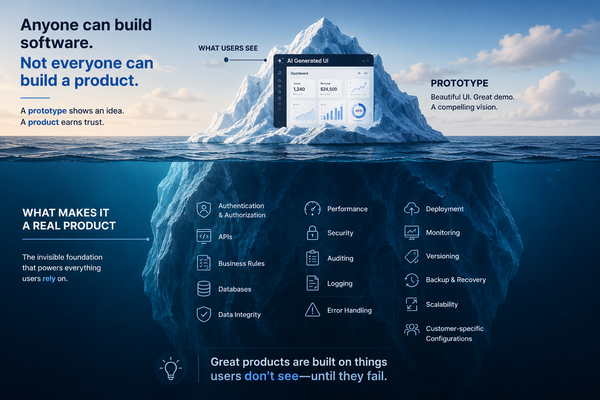
AI helped write code.
Production still demanded ownership.
7. My Biggest Takeaway
I didn't feel like AI replaced software development.
It changed my role.
Less time writing boilerplate.
More time:
- making decisions;
- refining experiences;
- validating assumptions;
- thinking about the system.
And perhaps that's the biggest shift:
AI doesn't eliminate engineering. It moves engineering higher up the stack.
Closing Thought
I didn't set out to prove that AI could replace developers. I wanted to see whether it could help me ship real software. After rebuilding an application from the ground up, my conclusion is surprisingly simple: AI is an incredible accelerator, but not an autopilot. The code may come easier, but ownership doesn't. Architecture, trade-offs, deployment, and judgment still belong to us. In many ways, AI didn't make engineering less important—it made the human parts of engineering more important than ever.