The Hidden Cost of Always Solving Problems Yourself
Hero mode may help a leader win the day, but it weakens the system. Real leadership is not being the only person with answers — it is building a team that can make better decisions without always waiting for you.
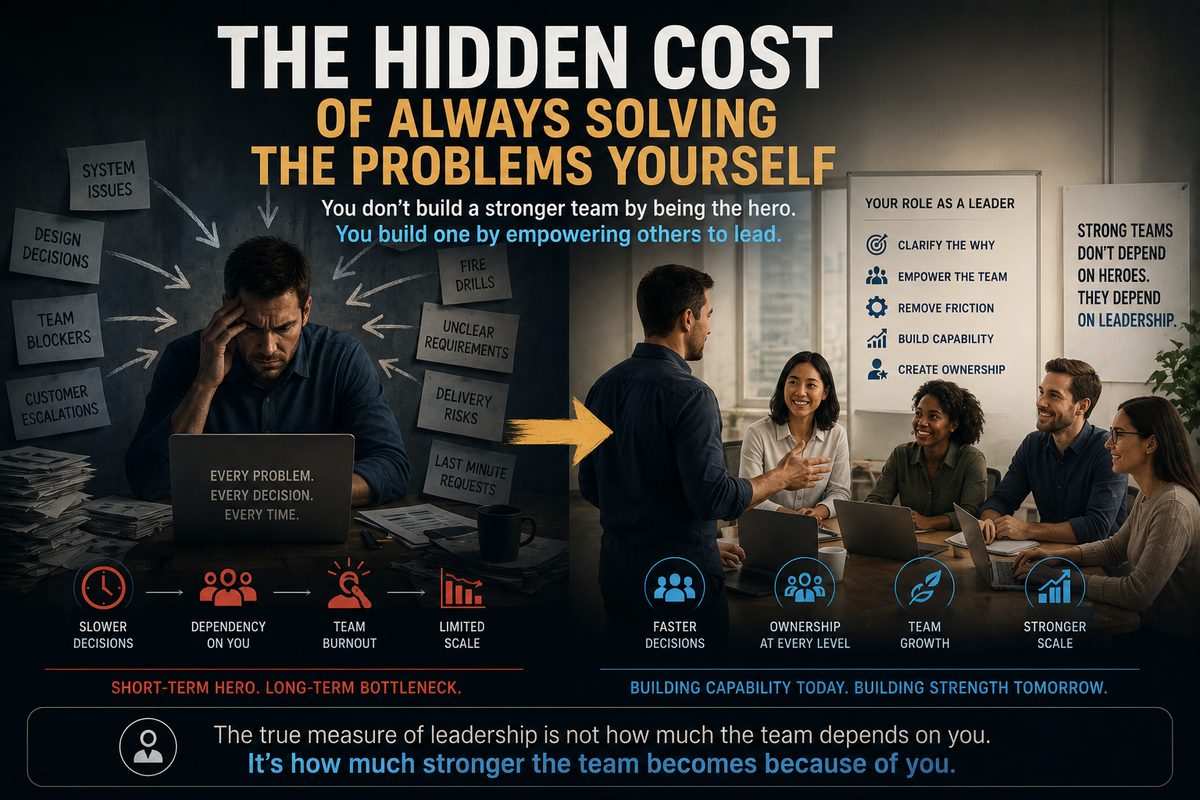
The fastest way to slow down a team is to have a leader who still wants to be the hero.
This happens often in engineering.
A strong technical contributor moves into leadership. They know the systems. They know the history. They can solve problems quickly. So, when something breaks, they jump in. When a design is unclear, they decide. When the team hesitates, they take over.
At first, it looks like ownership.
Over time, it becomes a bottleneck.
Leadership is not about proving you are still the smartest person in the room. It is about building a team that can make good decisions without waiting for you every time.
That shift is not easy.
As a technical leader, your instinct is to answer the “how.”
§ How should we fix this?
§ How should we design this?
§ How should we handle this customer issue?
§ How should we unblock this delivery risk?
But when you move into management, your role changes.
Most of the time, your team should own the “how.”
Your job is to make sure everyone understands the “why.”
§ Why are we doing this?
§ Why does this matter to the customer?
§ Why is this the priority now?
§ Why does this align with the broader organizational goal?
That is where leadership starts to scale. Most leaders fail to address the “why”, they even never bring that up which causes team to act out of obedience instead of understanding.
Delegation is not just about reducing your workload. It does much more than that.
§ It builds trust.
§ It gives others the opportunity to grow.
§ It creates space for people to showcase their skills.
§ It allows decisions to happen closer to the work.
§ It gives you the capacity to focus on people, delivery, strategy, and organizational alignment.
When you do not delegate, you may still get things done — but only through yourself.
That is not scale. That is dependency. And dependency creates a fragile team.
If every important decision must go through you, the team will eventually slow down. Work starts waiting in line. People stop taking ownership. Managers become overloaded. Delivery becomes congested. And what looked like strong leadership turns into operational drag.
The problem is not that the leader lacks effort.
The problem is that effort is pointed in the wrong direction.
Hero mode feels productive because you are solving visible problems. But leadership is often about solving the invisible ones:
§ Are people growing?
§ Are decisions clear?
§ Are priorities understood?
§ Are teams empowered?
§ Are we building capability, or just completing tasks?
§ A leader stuck in hero mode may win the day, but they weaken the system.
§ A leader who delegates well may move slower in the moment, but they build a stronger engine for the future.
This does not mean leaders should disappear.
There are moments when you need to step in. There are moments when you need to guide closely. There are moments when the situation requires direct decision-making.
But that should be intentional, not habitual.
The goal is not to remove yourself from the work.
The goal is to stop making yourself the only path through which work can move.
That is the real transition from technical lead to manager.
You stop trying to be the person with every answer.
You become the person who creates clarity, builds ownership, removes friction, and helps others become capable of answering without you.
Because the true measure of leadership is not how much the team depends on you.
It is how much stronger the team becomes because of you.
So, the question is simple:
Are you solving problems in a way that builds the team — or in a way that keeps the team waiting for you?