Is your Team Actually AI Ready?
AI readiness is not measured by how many tools your team has access to. It is measured by whether people know how to use AI responsibly, thoughtfully, and consistently to improve real work.
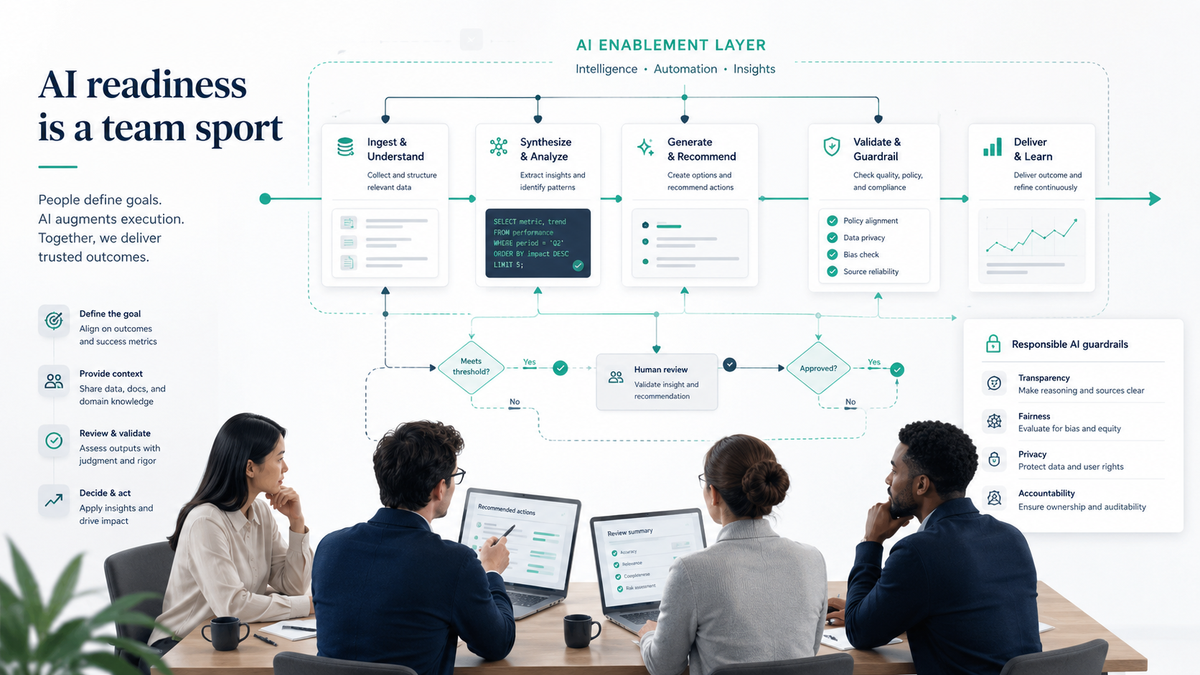
Everyone is asking the same question right now: “Which AI tool should my team use?”
It sounds like the right question. It isn’t.
Because I’ve seen teams with the best tools make zero progress…and teams with average tools move 10x faster.
So, let’s get real — AI readiness is not a tooling problem. It’s a mindset and operating problem.
The Trap: Tool-First Thinking
Leaders are rolling out tools like:
- GitHub Copilot
- Cursor
- ChatGPT
- Claude
- Notion
And expecting transformation.
But here’s what actually happens:
- Teams use AI like a faster Google
- Outputs are accepted without thinking
- Productivity spikes briefly… then plateaus
- They build code, but don’t know internals of it
- Frustration sets in: “AI didn’t work for us”
The tool didn’t fail. The approach did.
What AI-Ready Teams Actually Look Like
AI-ready teams don’t start with tools. They start with how they think.
There are three shifts I consistently see in teams that succeed:
1. From “Execution” → “Exploration”
Most engineering teams are trained to execute:
- Take requirements
- Write code
- Deliver
AI changes that dynamic.
Now the real advantage comes from:
- Asking better questions
- Exploring multiple approaches
- Iterating quickly before committing
AI amplifies curiosity. If curiosity is missing, AI has nothing to amplify.
2. From “Answer Seeking” → “Problem Framing”
Weak AI usage looks like: “Write me code for X”
Strong AI usage looks like: “Here’s the problem, constraints, edge cases, trade-offs — explore options with me”
Teach your teams:
- How to break down ambiguous problems
- How to provide context
- How to iterate on responses
AI is not a solution engine. It’s a thinking partner.
3. From “Individual Productivity” → “Collective Maturity”
Most teams treat AI as an individual tool. That’s a mistake.
Real gains happen when:
- Patterns are shared
- Prompts evolve into reusable assets
- Teams learn from each other
This is where leadership matters:
- Create forums to share AI usage
- Normalize experimentation
- Reward learning, not just output
- Create discussion channels / Experience sharing – everyone is equal in this.
AI maturity is a team sport, not an individual hack.
What Leaders Should Actually Do
If you’re serious about AI readiness, focus here:
1. Don’t start with tools — start with intent
- What problems are we trying to solve faster?
- Where do we want better thinking, not just faster output?
2. Train for thinking, not prompting
- Teach problem decomposition
- Encourage iterative conversations with AI
- Push teams to challenge outputs
3. Create safe space for exploration
- AI usage should not feel like a performance test
- Early-stage inefficiency is part of the process
4. Build internal momentum
- Highlight wins
- Share failures without blame
- Let curiosity spread organically
The Hard Truth
You can give every engineer the best AI tools available…
But if they are not:
- Curious
- Willing to learn
- Comfortable exploring the unknown
Nothing will change.
The Real Question
So before asking: “Which AI tool is right for my team?”
Ask: “Do I have a team that thinks like explorers?”
Because in the AI era…Tools are available to everyone. Mindsets are not.