Know Your Folks
Leadership begins with understanding people before managing work.
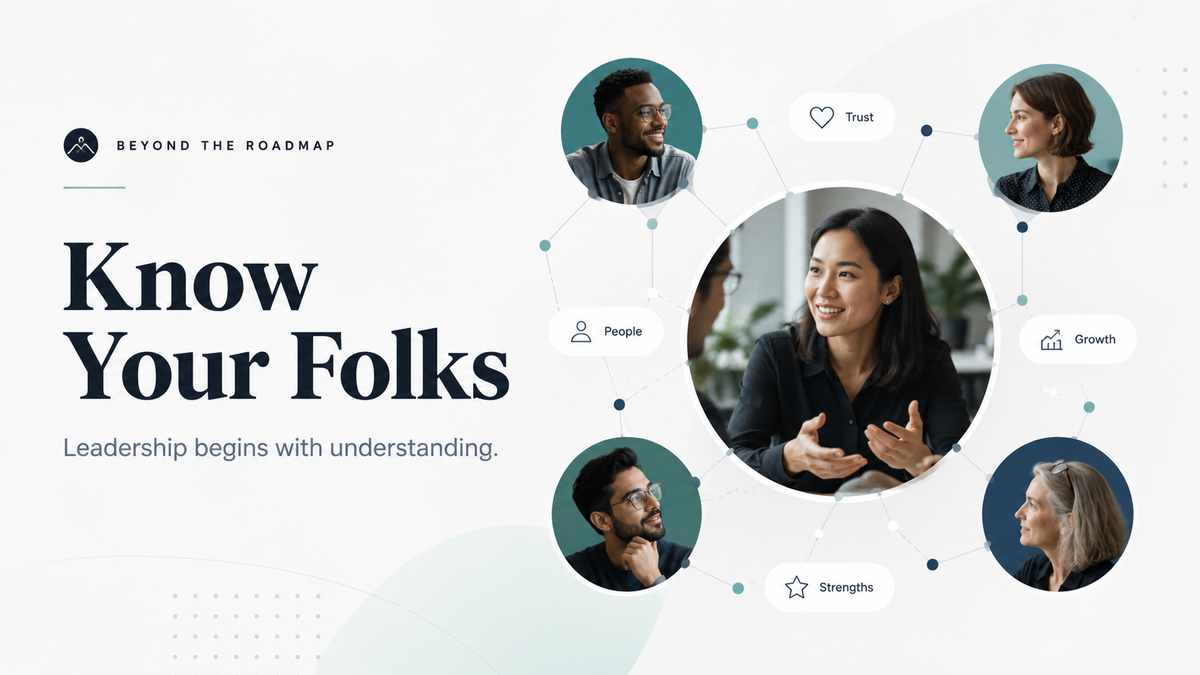
Leadership begins with understanding—not managing.
Leadership doesn’t begin with strategy.
It doesn’t begin with targets.
It begins with understanding.
Not managing people — understanding them.
Too often, leaders jump straight into performance, delivery, and outcomes. But the leaders who consistently build strong teams do something different:
They know their people—deeply and intentionally.
What Does “Knowing Your Folks” Actually Mean?
It’s not surface-level familiarity. It’s not just knowing names and roles.
It’s knowing:
· What each person is naturally good at
· Where their interests truly lie (not just what they’re assigned)
· Their professional journey — what shaped them
· Their aspirations — where they want to go
· Where they feel they struggle
· And importantly, where they actually need support
If they’re open to it, it also means understanding:
· What’s happening in their personal world
· What pressures or priorities they carry outside of work
Because whether we acknowledge it or not—people don’t leave their lives at the door when they log in.
Intent Matters More Than Information
Here’s where many leaders go wrong.
They gather this information…
…and immediately try to map it to performance, roles, or organizational needs.
That’s too early.
When you’re learning about your people, do it with one intent only:
To understand them—not to use them.
The alignment to business goals?
That’s your job as a leader—but it comes later.
If you rush that step, people feel it. And when they do, trust never fully forms.
What You Get in Return: Trust
And trust changes everything.
Because at the end of the day:
People don’t work for companies. They work for people.
When your team knows you genuinely understand them, something shifts:
· They open up more
· They take ownership
· They push harder—not because they have to, but because they want to
At that point, your role flips:
You’re not the boss people work for.
You’re the person working for your team.
Know their limits – And stretch them thoughtfully
Once you understand your people, you also understand their limits and how far you can stretch them.
Good leaders:
· Know each person’s current limit
· Are willing to test that boundary occasionally
· But never push blindly
Growth doesn’t come from comfort—but it also doesn’t come from breaking people.
It comes from intentional stretches.
Praise in Public. Correct in Private.
This sounds simple. It isn’t.
· Be your team’s loudest advocate in public
· Be their most honest mirror in private
And yes—have the hard conversations.
Avoiding them doesn’t protect people. It delays growth.
Invest in People. Everything Else Follows.
When you invest in understanding your people:
· Alignment becomes easier
· Performance becomes natural
· Culture becomes stronger
But more importantly—
You build a team that chooses to stay, grow, and deliver with you.
Final Thought
If there’s one shift to make as a leader, it’s this:
Stop asking, “How can my team deliver more?”
Start asking, “How well do I actually know my people?”
Because once you truly know your folks — Everything else gets easier.