Leadership vs Management
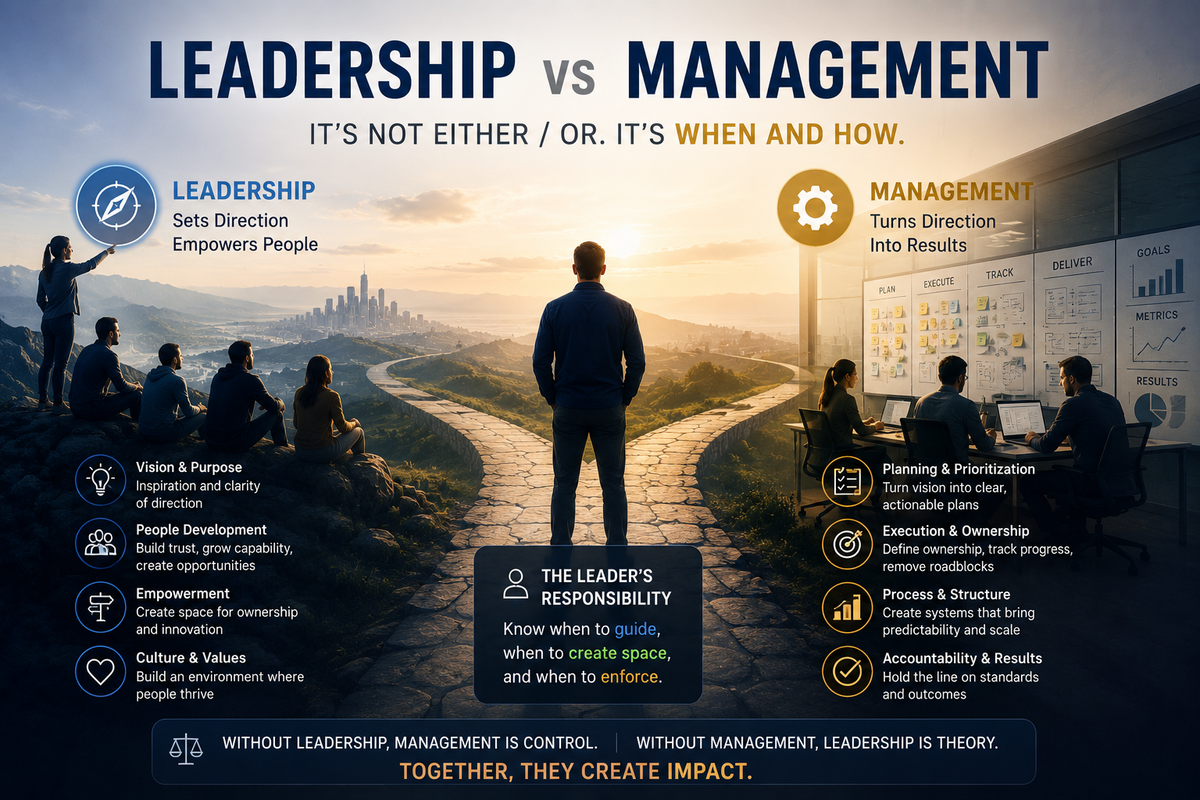
Leadership and management are not opposite skills. Real leadership is knowing when to guide, when to create space, when to show by example, and when to enforce the standards that make teams successful.
A lot of people describe leadership and management like they are opposite skills.
|
Leadership |
Management |
|
Leadership
is vision. |
Management
is execution. |
|
Leadership is people. |
Management is process. |
|
Leadership
is soft. |
Management
is hard. |
I do not fully agree.
In the real world, especially in engineering and product delivery, the line is not that clean.
Þ A strong leader still needs discipline.
Þ A strong manager still needs vision.
Þ A strong organization needs both.
The difference is not soft vs hard. The difference is not people vs delivery.
The difference is knowing when to guide, when to create space, and when to enforce.
Leadership is not about avoiding structure
Some people think leadership means giving inspirational talks and letting teams “figure it out.”
That is not leadership.
Leadership is about creating a path where people can succeed. Sometimes that means giving direction. Sometimes that means removing blockers. Sometimes that means helping someone see a solution they were already close to finding.
And sometimes, it means stepping in and saying:
“This is the standard. This is the expectation. This cannot continue this way.”
That is not micromanagement. That is responsibility.
The key is knowing the difference between a team that needs space and a team that needs clarity.
Management is not just about tracking tasks
Management gets a bad reputation because people reduce it to status updates, deadlines, spreadsheets, and follow-ups.
But good management creates predictability.
§ It turns vision into work.
§ It turns ideas into execution.
§ It turns ambiguity into decisions.
Without management, leadership becomes theory.
Without leadership, management becomes control.
The best engineering leaders understand both. They can talk about strategy, but they can also ask the practical questions:
· What is the path?
· Who owns it?
· What is blocked?
· What decision is needed?
· What risk are we ignoring?
· Are we solving the right problem?
That is where real leadership shows up.
It is not people vs delivery
This is one of the biggest traps leaders fall into.
· Some leaders over-index on delivery and burn people out.
· Some over-index on comfort and avoid accountability.
Neither works for long.
In the corporate world, both people and delivery matter.
You cannot ignore delivery and call yourself people-focused. The business still has commitments, customers, revenue, and outcomes.
You also cannot ignore people and call yourself delivery-focused. Tired, confused, unsupported teams do not produce sustainable results.
A leader’s job is not to choose one over the other.
A leader’s job is to bring them closer.
That means building a system where delivery is clear, expectations are realistic, priorities are understood, and people are trusted to do good work.
Know when to guide and when to enforce
This is where leadership becomes situational.
Sometimes you guide:
§ You ask questions.
§ You create room for others to think.
§ You let people own the solution.
§ You identify the champion and give them the opportunity to lead.
Sometimes you show by example:
§ You step into the complexity.
§ You model the thought process.
§ You demonstrate what good looks like.
And sometimes you enforce:
§ Not because you want control.
§ Not because your title gives you authority.
But because standards matter.
§ If quality is slipping, you address it.
§ If ownership is missing, you clarify it.
§ If timelines are unrealistic, you reset them.
§ If behaviors are damaging the team, you do not ignore them.
Leadership is not always about being liked in the moment. It is about being trusted over time.
Respect is not demanded
A title may give you authority. It does not give you respect.
Respect is earned by consistency, judgment, fairness, and follow-through:
§ People watch how you handle pressure.
§ They watch whether you protect the team or hide behind them.
§ They watch whether you give credit or collect it.
§ They watch whether you make hard calls when they are needed.
Once you earn respect, the responsibility becomes even bigger.
You have to maintain it.
Because trust takes time to build and very little time to damage.
The real job of a leader
Leadership is not about being the smartest person in the room.
It is about creating an environment where the smartest ideas can surface, where capable people can step up, and where the organization can move forward with clarity.
§ You serve the people.
§ You serve the organization.
§ You create opportunities.
§ You build confidence.
§ You create accountability.
§ You make success repeatable.
And when your people and organization succeed, your success usually follows.
That is the part many leaders miss.
Leadership is not about proving your value every day by being at the center of everything.
It is about building something that works even when you are not in the room.
So maybe the real question is not:
“Am I a leader or a manager?”
Maybe the better question is:
“Do I know what my team needs from me right now — guidance, space, example, or enforcement?”